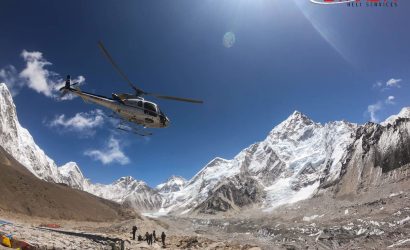
Daily Lobuche → Kathmandu Flight Schedule/Timetable
| Flight route | Dep. Time | Seats |
|---|---|---|
| Lobuche to Kathmandu | 06:40 AM | 4 Seating Capacity |
| Lobuche to Kathmandu | 08:10 AM | 4 Seating Capacity |
| Lobuche to Kathmandu | 10:40 AM | 4 Seating Capacity |
Find Schedule
View fixed departures and shared helicopter seats on our schedule page.
The Lobuche to Kathmandu Helicopter Flight is the most efficient, high-end, and safety-oriented way to exit the Everest region, eliminating days of trekking and the dependency on Lukla’s congested fixed-wing airport.
Designed for trekkers, climbers, expedition teams, and emergency-ready travelers, this direct helicopter transfer connects the high Himalaya to Nepal’s capital in one continuous flight, offering unmatched convenience, speed, and operational reliability.
At LuklaHelicopter.com, we specialize in high-altitude helicopter logistics, coordinating shared and private flights from Lobuche directly to Kathmandu, under strict Himalayan aviation and safety protocols.
Know before you fly
Helicopter access in the Everest region depends on terrain, altitude, and weather conditions. Learn how safety and operational decisions are made and what makes Lukla a special landing environment .
Why Fly Directly from Lobuche to Kathmandu?
Descending from Lobuche on foot typically requires 3–5 days of trekking, followed by uncertainty at Lukla due to weather delays, flight congestion, and cancellations.
A direct helicopter flight from Lobuche to Kathmandu:
- Removes the Lukla bottleneck entirely
- Reduces altitude exposure immediately
- Minimizes physical exhaustion after EBC or summit days
- Provides predictable logistics for onward international travel
For many trekkers and climbers, this route is not a luxury — it is a strategic safety and time-management decision.
Who Is This Flight Ideal For?
Everest Base Camp Trekkers
After reaching Everest Base Camp or Kala Patthar, many trekkers choose a helicopter return to Kathmandu to avoid retracing the same trail.
Peak Climbers (Lobuche East, Island Peak, Ama Dablam)
Post-summit fatigue and dehydration make helicopter extraction the safest exit strategy.
Expedition & Logistics Teams
Used for:
- Crew rotation
- Equipment repositioning
- Time-critical logistics
- Medical stand-by exits
Medical, Insurance & Assistance Clients
This route is commonly used for non-emergency but urgent extractions, especially when walking down poses health risks.
Route Overview: Lobuche → Kathmandu
- Departure: Lobuche (≈ 4,940 m)
- Arrival: Kathmandu (≈ 1,400 m)
- Flight Duration: 60–75 minutes (weather & routing dependent)
- Aircraft: High-altitude AS350 / Bell 407 class helicopters
- Flight Corridor: Everest (Khumbu) – Himalayan mid-hills – Kathmandu Valley
The flight offers dramatic aerial views of:
- Khumbu Glacier & Everest Base Camp
- Nuptse, Pumori & Ama Dablam
- Dudh Koshi Valley
- Himalayan foothills transitioning into Kathmandu Valley
Can Helicopters Fly Directly from Lobuche to Kathmandu?
Yes — but only under suitable weather, weight, and fuel conditions.
Due to extreme altitude and density-altitude limitations:
- Some flights may require technical fuel stops (e.g., Lukla or lower valleys)
- Payload may be adjusted
- Luggage limits are strictly enforced
These decisions are engineering-driven safety measures, not operational shortcomings.
Shared vs Private Helicopter Options – Lobuche to Kathmandu helicopter flight
Shared Helicopter (Cost-Optimized)
- Seats shared with other trekkers
- Fixed payload limits per passenger
- Scheduled around optimal weather windows
- Most popular during peak trekking seasons
Private Helicopter Charter (Maximum Flexibility)
- Exclusive use of aircraft
- Flexible timing
- Ideal for families, expeditions, or insurance cases
- Higher cost, highest reliability
Our operations team actively manages seat matching and payload optimization to keep shared flights safe and economical.
Weight, Altitude & Engineering Constraints
Flying from nearly 5,000 meters to Kathmandu requires advanced performance planning.
Key safety considerations:
- Passenger body weight
- Backpack & duffel weight
- Fuel load vs lift capability
- Temperature & density altitude
- Wind and terrain effects
In some cases:
- Luggage may be flown separately
- Multiple shuttle rotations may be required
- Flight timing may shift to early morning
These are standard Himalayan aviation protocols.
Weather & Flight Reliability
Weather is the single most important factor.
Best Flying Window
Early morning (6:00–10:00 AM)
This minimizes wind turbulence and cloud buildup.
Common Weather Challenges
- Afternoon cloud formation
- Valley wind shear
- Snowfall at high helipads
- Visibility constraints
If flights are delayed:
- Passengers are prioritized in next clear window
- Transparent rescheduling options provided
- Refund or alternative routing discussed clearly

Seasonal Availability
| Season | Flight Feasibility |
|---|---|
| Spring (Mar–May) | Excellent |
| Monsoon (Jun–Aug) | Limited / selective |
| Autumn (Sep–Nov) | Excellent |
| Winter (Dec–Feb) | Weather-dependent |
Spring and autumn are peak seasons due to stable air, trekking demand, and clear visibility.
Pricing Overview (Indicative)
Pricing depends on:
- Passenger count
- Payload & weight distribution
- Season
- Fuel prices
- Weather routing
Shared Flight:
Price per seat (subject to grouping)
Private Charter:
Price per helicopter (quoted individually)
Exact pricing is always confirmed on inquiry — no hidden fees.
What’s Included in Our Service?
- Flight coordination & scheduling
- Weight & safety calculations
- Weather monitoring & pilot briefing
- Ground coordination at Lobuche
- Kathmandu landing arrangements
- Operations support throughout
Optional support:
- Hotel or airport transfers in Kathmandu
- Insurance documentation coordination
- Rescue-to-logistics transition handling
Helicopter Pilots & Safety Standards
All flights operate with:
- CAAN-certified helicopter operators
- High-altitude-experienced pilots
- Regular maintenance audits
- Everest-specific operating procedures
Pilots assigned to this route routinely handle:
- Glacier landings
- Confined high-altitude helipads
- Complex terrain & weather transitions
Safety is non-negotiable.
Environmental Responsibility
We follow:
- Minimal hover time policy
- Shared-seat optimization
- Noise-sensitive flight paths
- Coordination with local authorities
Helicopter usage is treated as logistics & safety infrastructure, not recreational overuse.
Frequently Asked Questions
Is this an emergency evacuation?
No. This is a planned logistics flight. Emergency evacuations follow separate medical protocols.
How much luggage can I carry?
Typically 5–10 kg per passenger, depending on total payload.
Can the flight be delayed?
Yes, due to weather or safety limits. Transparency and passenger safety come first.
Is Lukla avoided completely?
In most cases, yes. However, technical stops may occur if required for safety.
Why Book with LuklaHelicopter.com?
We are not a generic travel agent.
We are:
- Everest-region helicopter specialists
- Safety-driven flight coordinators
- Transparent pricing advocates
- Trusted by trekkers, expeditions & insurers
Our role is to bridge aviation engineering with mountain logistics — professionally and responsibly.