
In Nepal, helicopter safety is governed less by schedules and more by physics. Among all operational factors, weight, balance, and altitude form the foundation of every safe flight. These factors are invisible to passengers, but they determine whether a helicopter can lift safely, hover stably, land with margin, and — just as importantly — depart again.
This page explains weight and balance in plain language, grounded in real Himalayan operating conditions. It exists to replace confusion with understanding — and to explain why payload limits are not commercial decisions, but non-negotiable safety constraints dictated by air density, temperature, terrain, and aircraft design .
A helicopter’s ability to fly depends on how much air its rotor system can accelerate downward. When air is dense, lift is easier. When air becomes thin — as it does at altitude or in warm temperatures — lift capability decreases dramatically.
In Nepal, helicopters operate in one of the most punishing environments on Earth: high elevation, steep terrain, confined landing zones, and rapidly changing weather. Every kilogram onboard directly affects rotor efficiency, climb performance, and hover capability.
This is why payload limits exist. They are not arbitrary, and they are not flexible once performance margins are reduced.
Density altitude is the single most important performance concept in Himalayan helicopter flying. It combines three factors:
- Actual altitude above sea level
- Air temperature
- Atmospheric pressure
As altitude increases, air becomes thinner. As temperature increases, air expands and becomes thinner. The helicopter does not “feel” altitude — it feels air density.
A helicopter sitting at 4,000 meters on a warm afternoon may perform as if it were at 6,000 meters. This invisible penalty dramatically reduces lift margin.
At sea level, helicopters often operate far below their maximum limits. In the Himalaya, helicopters frequently operate at the edge of their performance envelope.
Reducing passenger count, baggage weight, or fuel load is often the only way to preserve safe margins. This is not about maximizing profit — it is about ensuring:
- Safe hover during landing and pickup
- Controlled climb away from terrain
- Ability to abort safely if conditions change
Adding even a small amount of extra weight can eliminate those margins entirely.
Helicopter safety is not only about how much weight is onboard, but where that weight is placed. Incorrect balance affects control authority, rotor efficiency, and stability.
In confined mountain landing zones, precise balance is essential. A poorly balanced load can increase pilot workload at the exact moment when margins are already thin.
- “One extra bag won’t matter.” At altitude, it often does.
- “We flew full yesterday.” Yesterday’s temperature and pressure may have been different.
- “Other helicopters took more people.” Aircraft type and conditions vary.
- “Can’t you just try?” Aviation safety is never trial-and-error.
The Pilot-in-Command is legally and ethically responsible for ensuring that every flight operates within certified performance limits.
Payload reductions, delays, or split flights are safety decisions — not service failures.
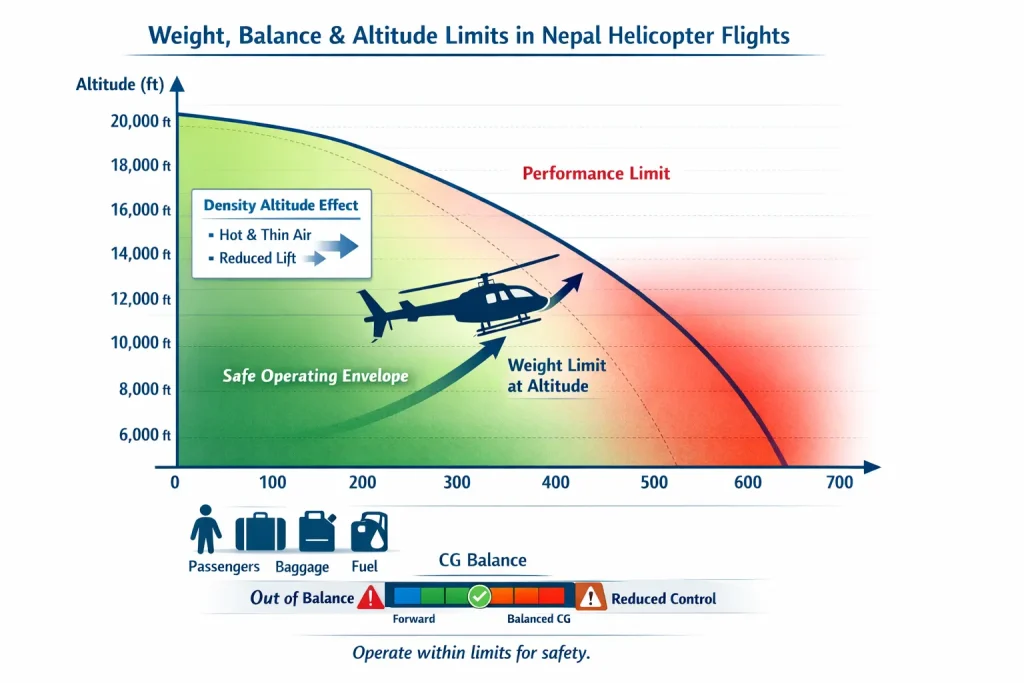
This diagram illustrates how payload weight and altitude directly limit helicopter performance in Nepal’s high mountains. As altitude increases and air becomes thinner, the safe operating envelope narrows, meaning helicopters must reduce weight and maintain correct balance to fly safely. The image highlights why these limits are engineering and safety constraints, not commercial choices
Helicopter access in the Everest region is closely tied to geography, altitude, and local weather patterns. Each destination below represents a distinct operating environment, with different safety considerations, landing conditions, and decision-making limits for pilots and operators.
Lukla
The primary aerial gateway to the Khumbu, where traffic volume, terrain, and short weather windows define operations.
Namche Bazaar
The region’s commercial and logistical centre, commonly used for transfers, repositioning flights, and emergency access.
Pheriche
A high-altitude settlement associated with acclimatization and medical response, where wind and density altitude are key factors.
Gorakshep
An extreme operating environment near Everest Base Camp, governed by strict payload limits and visual flight conditions.
Everest Base Camp
A dynamic glacial zone where helicopter access depends on surface conditions, safety margins, and real-time assessment.