
High-altitude helicopter flight is not an extension of normal aviation. It is a fundamentally different operating environment where physics, human physiology, terrain geometry, and weather interact in ways that rapidly compress safety margins.
In Nepal, helicopters routinely operate between 2,800 and 5,500 meters above sea level, often in narrow valleys with limited landing options and rapidly changing weather. At these altitudes, performance degradation is not theoretical — it is immediate and measurable.
This page explains high-altitude flight risk in plain, operational language. It exists to clarify why altitude matters, why “experience” is critical, and why the safest Himalayan operators are those who cancel early rather than press on.
Altitude does not introduce one problem; it amplifies many problems simultaneously. As elevation increases, helicopters face reduced lift, reduced engine output, reduced rotor efficiency, and reduced climb performance — all at the same time.
Unlike mechanical failures, altitude risk is gradual and deceptive. The helicopter continues to fly — until it no longer has margin. By the time performance limits are obvious, recovery options may already be gone.
This is why altitude safety is managed proactively. Operators do not wait for performance to degrade visibly; they plan to avoid operating near the edge in the first place.
Density altitude describes how “thin” the air behaves, not how high the helicopter is above sea level. It combines altitude, temperature, and atmospheric pressure into a single performance reality.
In the Himalaya, Density altitude can exceed physical elevation by a large margin. A helicopter operating at 4,300 meters on a warm afternoon may perform as if it were at 6,000 meters.
This invisible penalty directly reduces:
- Hover capability
- Climb gradient after takeoff
- Ability to arrest descent near terrain
- Payload margin for passengers, fuel, and equipment
Density altitude is why flights that are possible early in the morning may be unsafe later in the day — even with clear skies.
Helicopters rely on rotor downwash to generate lift. As air density decreases, the rotor must work harder to achieve the same effect. At high altitude, this reduces the margin between controlled hover and loss of lift.
Confined Himalayan landing zones magnify this risk. Slopes, obstacles, snow, and uneven surfaces leave little room for error. If hover margin is insufficient, safe landing may not be possible — even if the aircraft can technically reach the location.
This is why pilots may refuse to land at certain sites despite apparent accessibility. Landing without a guaranteed safe exit is not considered acceptable risk.
Altitude affects people as much as machines. Reduced oxygen availability impairs cognitive performance, slows reaction time, and increases fatigue — even in well-acclimatized individuals.
For pilots, this means:
- Reduced mental bandwidth under stress
- Higher workload during approach and departure
- Greater susceptibility to task saturation
For passengers and patients, altitude may worsen existing medical conditions, increase anxiety, or complicate rescue operations.
Conservative decision-making compensates for this physiological reality. It is not a weakness — it is professional discipline.
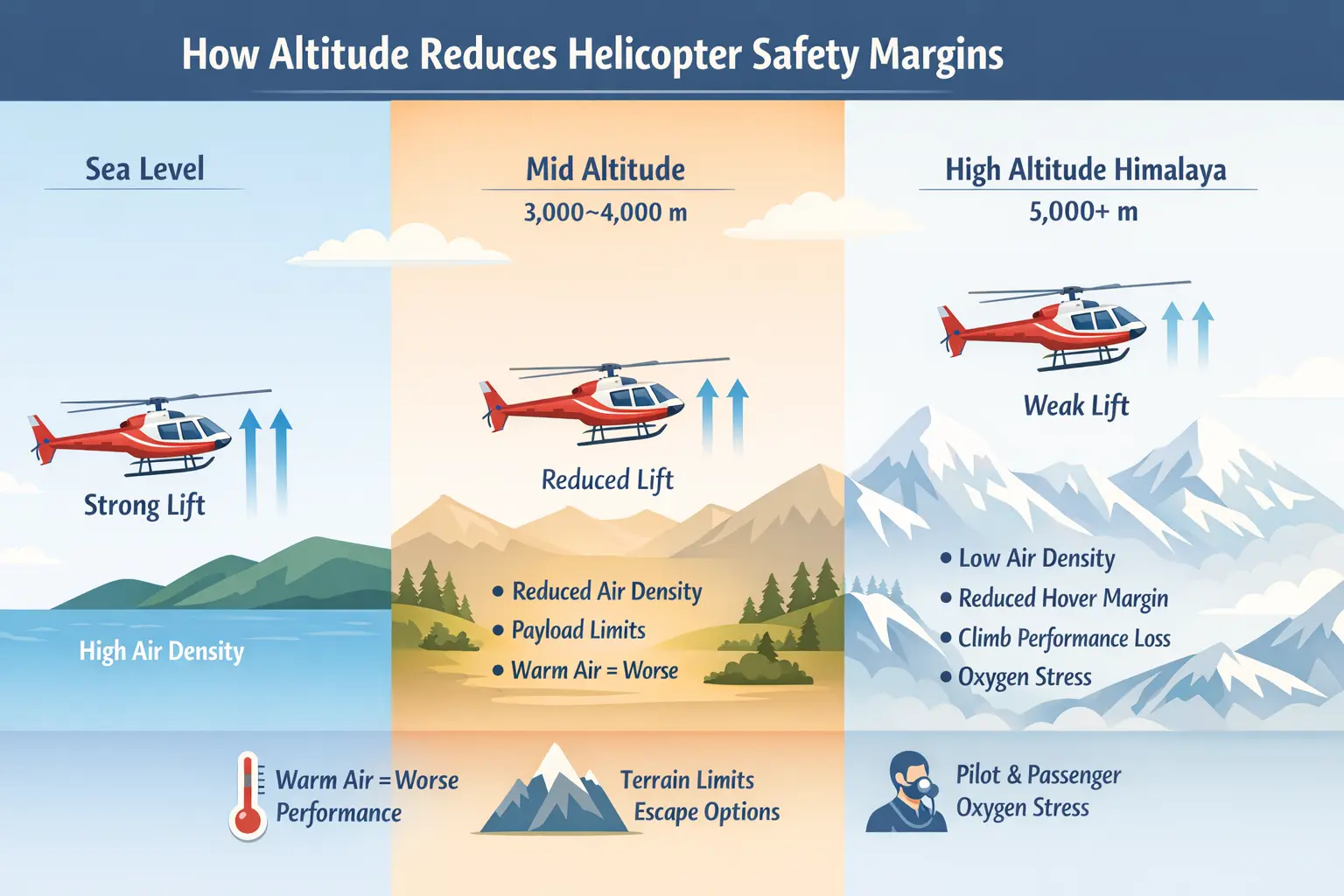
High-altitude terrain introduces hazards that are invisible to non-aviators. Snow cover erases depth perception. Steep slopes distort distance judgment. Valleys funnel wind unpredictably.
These factors create “terrain traps” — situations where a helicopter can enter an area but cannot safely turn, climb, or retreat once conditions change.
Experienced mountain pilots prioritize escape routes as highly as destinations. If a safe exit cannot be guaranteed, the mission is not considered viable.
Rescue and medical evacuation missions operate under different urgency frameworks. They may accept higher operational risk when the risk of inaction is greater.
However, even rescue flights are bounded by absolute safety limits. No mission is justified if it exceeds aircraft or pilot capability.
This distinction explains why a helicopter may evacuate a patient while refusing a planned transfer on the same day.
In high-altitude aviation, accidents rarely result from a single error. They emerge from gradual erosion of margins — small compromises that accumulate.
The safest operators share common traits:
- Early cancellations when trends deteriorate
- Aggressive payload reduction at altitude
- Clear refusal of external pressure
- Respect for Pilot-in-Command authority
This safety culture is not conservative for its own sake. It exists because the Himalaya does not forgive optimism.