
Emergency Rescue & Medical Evacuation Protocols in Nepal
LuklaHelicopter.com works only with licensed operators, rescue-trained pilots and professional medical partners to ensure safe, fast and ethical helicopter evacuations in the Himalayas. This page explains how emergency rescues are organised and what travelers and insurers can expect.
Focus: How rescues are done, high-altitude MEDEVAC protocols, communication chain, hospital partners and insurance requirements.
1. How Helicopter Rescues Are Done in Nepal
Rescue operations follow a structured, time-critical protocol led by licensed helicopter operators and coordinated with trekking guides, rescue coordinators and hospitals.
- Distress call initiated by guide, lodge or the patient (phone, radio or satellite device).
- Location & condition confirmed – altitude, GPS if available, type of illness or injury.
- Weather and terrain assessment by the operator and pilot.
- Helicopter dispatched from Lukla, Pheriche, Kathmandu or Pokhara depending on region.
- Safe landing or hover extraction selected based on ground conditions.
- Patient stabilisation with oxygen and basic medical support during evacuation.
- Transfer to hospital in Kathmandu or nearest medical centre depending on severity.
Note: Rescue pilots are different from standard sightseeing pilots – they are trained for unstable landing zones, time-pressure and altitude-related emergencies.
2. High-Altitude Medical Evacuation (MEDEVAC) Protocols
At extreme altitudes such as Pheriche, Lobuche, Gorakshep, Kala Patthar and Everest Base Camp, helicopter performance is reduced and medical risk increases quickly. For this reason, MEDEVAC flights follow strict guidelines:
- Passenger limit: Often a maximum of 1–2 patients from above ~4,500 m to maintain safe power margins.
- Oxygen onboard: For altitude sickness, HACE and HAPE cases, portable oxygen is used during flight.
- Rapid descent: Priority is to get the patient below 3,500 m as quickly and safely as possible.
- Hover or partial landing: If the ground is not stable, pilots may minimise ground contact time.
- Immediate medical evaluation: Doctors assess the patient on arrival and continue treatment with oxygen, medication or ICU if needed.
Why MEDEVAC matters: Many altitude-related illnesses can worsen in minutes, not hours. Early helicopter evacuation is often the difference between a full recovery and a life-threatening situation.
3. Communication Chain During a Rescue
A clear communication chain keeps everyone aligned and reduces delays.
1. Trekking Guide / Lodge
Initiates the rescue request, shares location, altitude and basic medical details.
2. Rescue Coordination Team
Confirms weather, identifies nearest helicopter base, and prepares operator & hospital information.
3. Helicopter Operator
Assigns rescue-qualified pilot, prepares aircraft, requests ATC clearance and confirms landing zone.
Behind the scenes: Air traffic control, local authorities, hospitals and insurance teams may all be involved in the same rescue.
4. Hospital Partners in Kathmandu
Most rescued trekkers and climbers are flown directly to hospitals in Kathmandu that handle international patients and altitude-related emergencies. Commonly used facilities include:
- CIWEC Hospital – specialist in travel and altitude medicine.
- NNepal Mediciti Hospital – advanced ICU and cardiac facilities.
- Grande International Hospital – full emergency and diagnostic support.
- Other partner hospitals depending on patient needs and bed availability.
Note: Patients suffering from HAPE or HACE typically require ICU-level monitoring and high-flow oxygen soon after arrival.
5. Insurance Requirements for Helicopter Rescue
Most helicopter rescues in Nepal are authorised and paid through travel insurance. To avoid delays:
- Your policy should clearly include helicopter evacuation up to at least 6,000 m.
- Keep your insurance policy number and emergency contact phone/email easily accessible.
- Some insurers require pre-approval; others allow immediate rescue with later verification.
- Make sure your family or trekking partner also knows how to contact your insurer.
Important: Without proper insurance, travelers may be asked for financial guarantees before or after rescue. Always confirm helicopter coverage before starting your trek.
6. What LuklaHelicopter.com Does During a Rescue
LuklaHelicopter.com is an agent and coordination partner – we do not operate helicopters ourselves, but we help bring the right people together quickly:
- Connecting guides and lodges with the nearest available rescue helicopter.
- Requesting rescue-qualified pilots from our partner operators whenever possible.
- Helping confirm insurance details and guarantee of payment where needed.
- Coordinating handover to hospitals and, when requested, updating families or assistance companies.
Need support for a rescue or insurance verification?
During trekking seasons, our team can help coordinate helicopter evacuations, liaise with operators and share local information with insurers and assistance companies.
WhatsApp / Viber: +977-9851312456
Email: info@luklahelicopter.com
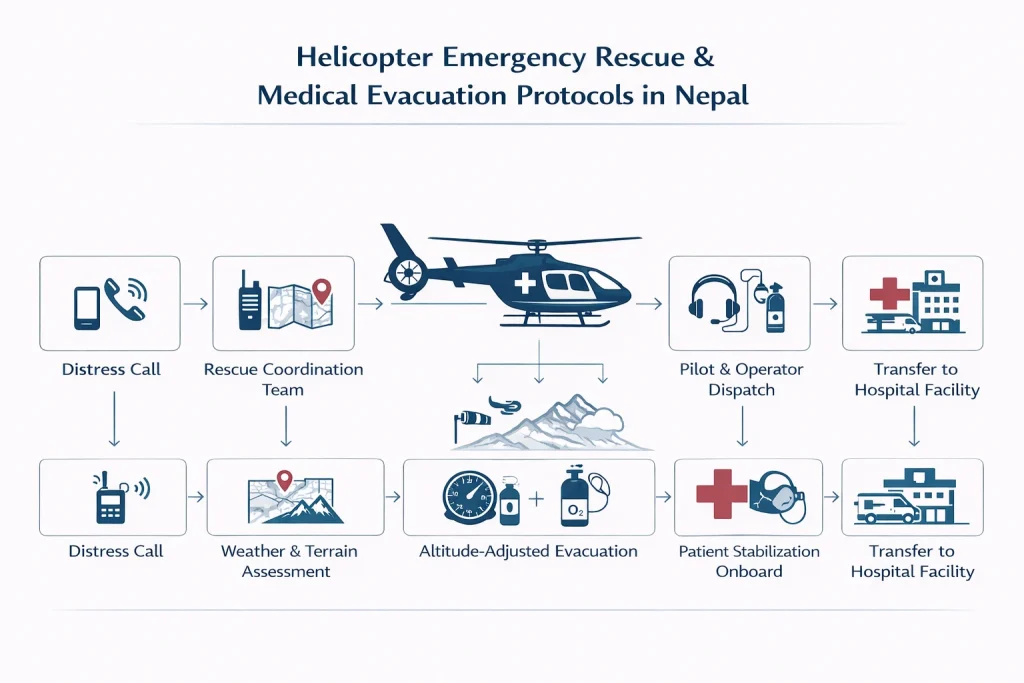
This diagram illustrates the structured sequence of helicopter emergency rescue and medical evacuation operations in Nepal. From the initial distress call and coordination phase through weather and terrain assessment, pilot dispatch, altitude-adjusted evacuation, and onboard patient stabilization, each step follows established safety and medical protocols before transferring the patient to a suitable hospital facility.